Showing posts with label information and interaction. Show all posts

Monday, February 13, 2012

Is Your Information Your Business?

The Business section is fast becoming the sociology of information section.

In "Twitter Is All in Good Fun, Until It Isn’t," David Carr writes about Roland Martin being sanctioned by CNN because of controversial Twitter posts.  On the Bits page, Nick Bolton's article "So Many Apologies, So Much Data Mining," tells of David Morin, head of the company that produces the social network app, Path ("The smart journal that helps you share life with the ones you love."), that got into hot water last week when a programmer in Singapore noticed it hijacked users' address books without asking. On page B3 we find a 14 inch article by T. Vega about new research from Pew about how news media websites fail to make optimal use of online advertising.

More on those in future posts.  Right next to the Pew article, J. Brustein's "Start-Ups Seek to Help Users Put a Price on Their Personal Data" profiles the startup "Personal" -- one of several that are trying to figure out how to let internet users capitalize on their personal data by locking it up in a virtual vault and selling access bit by bit.

This last one is of particular interest to me. Back in the early 90s I floated an idea that alarmed my social science colleagues: why not let study participants own their data? The idea was inspired by complaints that well-meaning researchers at Yale, where I was a graduate student at the time, routinely made their careers on the personal information they, or someone else, had collected from poor people in New Haven. The original source of that complaint was a community activist who had a more colorful way of describing the relationship between researcher and research subject.

The idea would be to tag data garnered in surveys and other forms of observation with an ID that could be matched with an escrow database (didn't really exist then, but now a part of "Software as a Service (Saas)"). When a researcher wanted to make use of data, she or he would include in the grant proposal some sort of data fee that would be delivered to the intermediary and then distributed as data royalties to the individuals the data concerned. The original researcher would still offer whatever enticements to participation (a bit like an advance for a book). The unique identifier held by the intermediary would allow data linking producing a valuable tool for research and an opportunity for research subjects to continue to collect royalties as their data was "covered" by new research projects just as a song writer does.

The most immediate objections were technical -- real but solvable, but then came the reasoned objections. This would make research more expensive! Perhaps, but another way to see this is that it would be a matter of more fully accounting for social costs and value, and for recognizing that researchers were taking advantage of latent value in their act of aggregation (similar to issues raised about Facebook recently). Another objection was that the purpose of the research was already to help these people. True enough. But why should they bear all the risk of that maybe working out, maybe not?

And so the conversation continued. I'm not sure I like the idea of converting personal information into monetary value; I think it sidesteps some important human/social/cultural considerations about privacy, intimacy, and the ways that information behavior is integral to our sense of self and and sense of relationships. But I do think it is critically important that we think carefully about the information order and how the value of information is created by surveillance and aggregation and how we want to think about what happens to the information we give, give up, and give off.

Related

Tuesday, June 21, 2011

Anonymity and the Demise of the Ephemeral

The New York Times email update had the right headline "Upending Anonymity, These Days the Web Unmasks Everyone" but made a common mistake in the blurb: "Pervasive social media services, cheap cellphone cameras, free photo and video Web hosts have made privacy all but a thing of the past."

It's going to be important in our policy conversations in coming months and years to get a handle on the difference between privacy and anonymity (and others such as confidentiality) and how we think about rights to, and expectations of, each.

There's a long continuum of social information generation/acquisition/transmission along which these various phenomena can be located:
  • artifactual "evidence" can suggest that someone did something (an outburst on a bus, a car  broken into, a work of art created)
  • meta-evidence provides identity trace information about the person who did something (a fingerprint, a CCTV picture, DNA, an IP address, brush strokes)
  • trace evidence can be tied to an identity (fingerprints on file, for example)
  • data links can suggest other information about a person so identified
Technology is making each of these easier, faster, cheaper and more plentiful.  From the point of view of the question, whodunnit?, we seem to be getting collectively more intelligent: we can zero in on the authorship of action more than ever before.  But that really hasn't much to do with "privacy," per se.

As Dave Morgan suggests in OnlineSpin (his hook was Facebook's facial recognition technology that allows faces in new photos to be automatically tagged based on previously tagged photos a user has posted) the capacity to connect the dots is a bit like recognizing a famous person on the street, and this, he notes, has nothing to do with privacy.

What it does point to is that an informational characteristic of public space is shifting.  One piece of this is the loss of ephemerality, a sharp increase in the half-life of tangible traces.  Another is, for want of a better term on this very hot morning in Palo Alto, "linkability"; once one piece of information is linked to another, it can easily be linked again.  And this compounds the loss of ephemerality that arises from physical recording alone.

From the point of view of the question asked above, the change can mean "no place to hide," but from the point of view of the answer, it might mean that the path to publicity is well-paved and short.

Some celebrate on both counts as a sort of modernist "the truth will out" or post-modernist Warholesque triumph.  But as pleased as we might be at the capacity of the net to ferret out the real story (the recent unmasking of "Gay Girl in Damascus" yet another example), the same structure can have the opposite effect.  The web also has immense capacity for the proliferation and petrification of falsehood (see, for example, Fine and Ellis 2010 or Sunstein 2009).

Thus, it may well be that the jury is still out on the net effect on the information order.

See also :"No Such Thing as Evanescent Data"

Friday, April 22, 2011

No Such Thing as Evanescent Data

Pretty good coverage of the "iphone keeps track of where you've been" story in today's NYT "Inquiries Grow Over Apple’s Data Collection Practices" and in David Pogue's column yesterday ("Your iPhone Is Tracking You. So What?"). Not surprisingly, devices that have GPS capability (or even just cell tower triangulation capability) write the information down. Given how cheap and plentiful memory is, not surprising that they do so in ink.

This raises a generic issue: evanescent data (information that is detected, perhaps "acted" upon, and then discarded) will become increasingly rare.  We should not be surprised that our machines rarely allow information to evaporate and it is important to note that this is not the same as saying that any particular big brother (or sister) is watching.  Like their human counterparts, a machine that can "pay attention" is likely to remember -- if my iPhone always know where it is, why wouldn't it remember where it's been? 

It's the opposite of provenience that matters -- not where the information came from but where it might go to.  Behavior always leaves traces -- what varies is the degree to which the trace can be tied to its "author" and how easy or difficult it is to collect the traces and observe or extract patterns they may contain.  These reports suggest that the data has always been there, but was relatively difficult to access.  It's only recently that, ironically, due to the work of the computer scientists who "outed" Apple, that there is an easy way to get at the information.

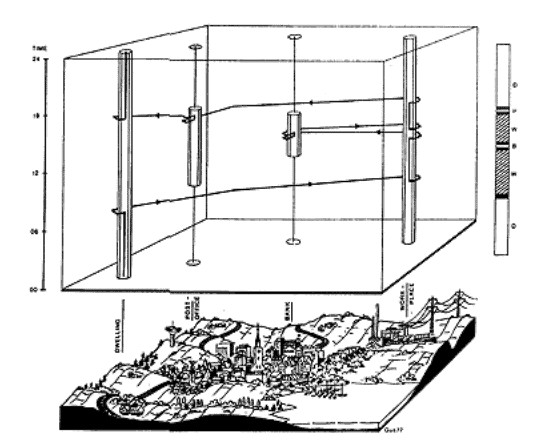
Setting aside the issue of nefarious intentions, we are reminded of the time-space work of the human geographers such as Nigel Thrift and Tommy Carlstein who did small scale studies of the space-time movements of people in local communities in the 1980s and since. And, too, we are reminded of the 2008 controversy stirred up when some scientists studying social networks used anonymized cell phone data on 100,000 users in an unnamed country.

Of course, the tracking of one's device is not the same as the tracking of oneself.  We can imagine iPhones that travel the world like that garden gnome in Amelie and people being proud not just of their own travels but where there phone has been. 

See also
  1. Technologically Induced Social Alzheimers
  2. Information Rot

Monday, December 13, 2010

An Interesting Web Book "App"

What reminds you of what? When one reads -- or hears about -- a book, one almost unconsciously make connections -- this book is a little bit like that book. When you tell someone you are interested in some topic s/he will often say, "well, then you should have a look at ...."

I just stumbled across a web resource, http://www.librarything.com/, that implements this as a combination of a personal library catalog and a social network.  It allows you, virtually, to surf your own library and connect from books you know to books that are related to it. Users "tag" books creating a interesting way to slice through the database. Try these, for example: sociology, history, philosophy, economics. And it keeps an eye on where a given book is available -- libraries, bookstores, online digital sources, used book networks (like abebooks.com).

When I played around with it looking for books on the sociology of information I got a bookshelf that nearly mirrored my the books in front of me on my study's shelves, but with a few titles I was unfamiliar with :