Showing posts with label technology. Show all posts

Friday, April 22, 2011

No Such Thing as Evanescent Data

Pretty good coverage of the "iphone keeps track of where you've been" story in today's NYT "Inquiries Grow Over Apple’s Data Collection Practices" and in David Pogue's column yesterday ("Your iPhone Is Tracking You. So What?"). Not surprisingly, devices that have GPS capability (or even just cell tower triangulation capability) write the information down. Given how cheap and plentiful memory is, not surprising that they do so in ink.

This raises a generic issue: evanescent data (information that is detected, perhaps "acted" upon, and then discarded) will become increasingly rare.  We should not be surprised that our machines rarely allow information to evaporate and it is important to note that this is not the same as saying that any particular big brother (or sister) is watching.  Like their human counterparts, a machine that can "pay attention" is likely to remember -- if my iPhone always know where it is, why wouldn't it remember where it's been? 

It's the opposite of provenience that matters -- not where the information came from but where it might go to.  Behavior always leaves traces -- what varies is the degree to which the trace can be tied to its "author" and how easy or difficult it is to collect the traces and observe or extract patterns they may contain.  These reports suggest that the data has always been there, but was relatively difficult to access.  It's only recently that, ironically, due to the work of the computer scientists who "outed" Apple, that there is an easy way to get at the information.

Setting aside the issue of nefarious intentions, we are reminded of the time-space work of the human geographers such as Nigel Thrift and Tommy Carlstein who did small scale studies of the space-time movements of people in local communities in the 1980s and since. And, too, we are reminded of the 2008 controversy stirred up when some scientists studying social networks used anonymized cell phone data on 100,000 users in an unnamed country.
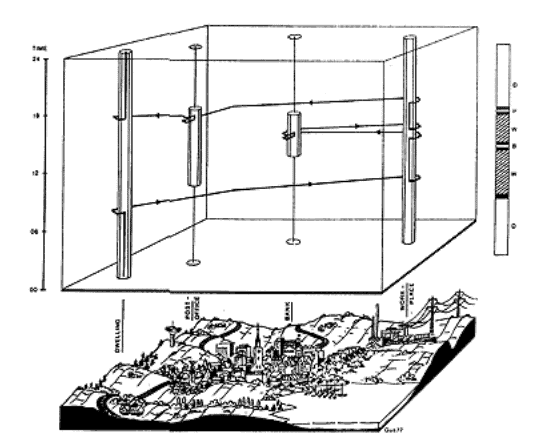
Of course, the tracking of one's device is not the same as the tracking of oneself.  We can imagine iPhones that travel the world like that garden gnome in Amelie and people being proud not just of their own travels but where there phone has been. 

See also
  1. Technologically Induced Social Alzheimers
  2. Information Rot

Tuesday, November 30, 2010

Leaking Irony

While I work on more extended analysis of the WikiLeaks situation (among other things the obvious connection to my work on how geometries of information sharing are co-constitutive of social relationships and statuses), a small irony must be noted.

Apparently, several news organizations have had the material recently made public since August.  Editors and reporters have been meeting in secret to develop protocols about what would be reported, when, and how.  Fortunately for their work, it appears that these journalists managed to do all of this while maintaining the kind of secrecy necessary for them to be able to process the information and to consider its meaning and its implications out of public view.  The public, media, and official reaction of the last few days make clear why this secrecy was necessary.

One thing that would be interesting to hear a story on would be what measures were taken to ensure the security of the process.  What sorts of technological tools were employed?  What sorts of social tools?  Did participants have to sign confidentiality agreements?   What prevented a rogue reporter from reporting on the reporters reporting?

Thursday, March 26, 2009

Information Rot

A whole chapter in my book on the sociology of information will be about information permanence and impermanence and so this posting by David Pogue caught my eye: "Should You Worry about Data Rot?" It's text of an interview that was a part of a video piece he did for CBS a few weeks ago. The basic idea is that we store our data on media that are subject to degradation and that require for play back hardware or software that have short lifetimes. We are left with the problem of constantly "migrating" our data to new formats.

An important observation : the pace at which data recording formats become obsolete and unreadable is accelerating. The experts cited in the piece suggest we are currently at the ten year mark -- at this point, one needs to migrate to new media every ten years.

The video piece ends with the observation that there's never been, nor ever will be, a data recording technology that lasts forever. Of course, one's first thoughts go to clay tablets from ancient Persia, which seem to have held up rather well. True, but of all the clay tablets ever produced, we have, in all likelihood, but a small fraction. But then, given what's on most of them (e.g., records of grain sale transactions or inventories of food storage), it's not clear that the information order is impoverished by their absence. Of what fraction of our current information holdings could the same be said of. One wonders, but one migrates one's own data, just in case.