Tuesday, June 21, 2011

Anonymity and the Demise of the Ephemeral

The New York Times email update had the right headline "Upending Anonymity, These Days the Web Unmasks Everyone" but made a common mistake in the blurb: "Pervasive social media services, cheap cellphone cameras, free photo and video Web hosts have made privacy all but a thing of the past."

It's going to be important in our policy conversations in coming months and years to get a handle on the difference between privacy and anonymity (and others such as confidentiality) and how we think about rights to, and expectations of, each.

There's a long continuum of social information generation/acquisition/transmission along which these various phenomena can be located:
  • artifactual "evidence" can suggest that someone did something (an outburst on a bus, a car  broken into, a work of art created)
  • meta-evidence provides identity trace information about the person who did something (a fingerprint, a CCTV picture, DNA, an IP address, brush strokes)
  • trace evidence can be tied to an identity (fingerprints on file, for example)
  • data links can suggest other information about a person so identified
Technology is making each of these easier, faster, cheaper and more plentiful.  From the point of view of the question, whodunnit?, we seem to be getting collectively more intelligent: we can zero in on the authorship of action more than ever before.  But that really hasn't much to do with "privacy," per se.

As Dave Morgan suggests in OnlineSpin (his hook was Facebook's facial recognition technology that allows faces in new photos to be automatically tagged based on previously tagged photos a user has posted) the capacity to connect the dots is a bit like recognizing a famous person on the street, and this, he notes, has nothing to do with privacy.

What it does point to is that an informational characteristic of public space is shifting.  One piece of this is the loss of ephemerality, a sharp increase in the half-life of tangible traces.  Another is, for want of a better term on this very hot morning in Palo Alto, "linkability"; once one piece of information is linked to another, it can easily be linked again.  And this compounds the loss of ephemerality that arises from physical recording alone.

From the point of view of the question asked above, the change can mean "no place to hide," but from the point of view of the answer, it might mean that the path to publicity is well-paved and short.

Some celebrate on both counts as a sort of modernist "the truth will out" or post-modernist Warholesque triumph.  But as pleased as we might be at the capacity of the net to ferret out the real story (the recent unmasking of "Gay Girl in Damascus" yet another example), the same structure can have the opposite effect.  The web also has immense capacity for the proliferation and petrification of falsehood (see, for example, Fine and Ellis 2010 or Sunstein 2009).

Thus, it may well be that the jury is still out on the net effect on the information order.

See also :"No Such Thing as Evanescent Data"

Wednesday, June 8, 2011

animal diminutives

At the risk of straying too far off the sociology of information trail, may I report a conversation from this morning's ride down to CASBS and request your assistance?

My ride partner mentioned a conversation with a "cub reporter" the other day.  Why, we wondered, is Ursus the right genus for journalists?  And what animal diminutives do we use for other professions?

If baby sharks are called pups, should new law firm associates be called pups? And those just getting started out in the human smuggling business? How about beginner loan sharks?  Or sleazy wheeler dealers at the start of their career: snakelets? Hatchlings?

If an editor has an eagle eye, is an editorial trainee a eaglet? Do others come to mind?

And back to the journalists: why are they bears?  OED gives first occurrence as 1899 J. L. Williams in Scribner's Mag.25 277 "The cub reporter and the king of Spain." and lists two other "cubs": engineer and (river boat) pilot (both from M. Twain. And one of the definitions of "cub" is "An undeveloped, uncouth, unpolished youth" with the explanation that it comes from the idea that "the young of the bear was fabled to be born in a shapeless condition, and afterwards licked into shape by the mother" and the earliest usage is Shakespeare in "Twelfth Night" (1623).

So, let me put the question out there -- do you know of any other animal diminutives that we apply to beginners in various professions or trades?

Tuesday, May 10, 2011

Adding Sociology of Information Blogs to the Blog Roll

Up to now our sidebar included the names of blogs that linked to The Sociology of Information. Now that the field has started to achieve something of a latent critical mass out there, I'm evolving the blog roll in the direction of "other blogs on the topic" which is really more useful.

First entry is Drew Conway's Zero Intelligent Agents blog. Drew is a PhD student in political science at New York University who studies terrorism and armed conflict using tools from mathematics and computer science. Much of the material on the blog is more on the techie side of things (it's an extremely useful resource in this regard) but interspersed with news about python routines and R utilities is much grist for the sociologist of information's mill.

Tuesday, May 3, 2011

Toward a Wikipedia of Sociology

Every few years one gets a request from the editor of an encyclopedia of social theory or globalization or social research.  Some publisher has succumbed to the idea that a new compendium is needed and some senior scholar has succumbed to the idea that "the time has come...."  Or, some senior scholar has managed to cajole some junior scholar into doing most of the work on a project that will bear the senior scholar's name.  OK, that last might be a little harsh.  What's next is someone conjures up a list of usual suspects (or, more likely, a series of database searches produces such a list).  Then someone sets up a content management system and an editor at the publisher solicits articles on behalf of the senior scholar editor -- usually with promise of a complimentary copy of the finished volume(s) as an honorarium

I wonder, though, if the days of this genre are numbered.  Would it not make sense to create an encyclopedia of sociology for and by card-carrying sociologists?  Mightn't crowd-sourcing disciplinary knowledge be superior to the limited intellectual resources represented by centrally selected article authors and the limited review of a small handful of editors?  I mean, the typical encyclopedia article probably has fewer peer reviews than most articles get.

What if a professional association opened up a wiki with a single restriction: you have to be a member to edit and you have to edit under your own identity.  Beyond that, no central control.

To be realistic, this is probably much more openness and flexibility than most professional associations could ever tolerate.  There'd have to be a committee of members and probably a report to the executive committee or something like that that would turn the endeavor into as close a clone of the traditional encyclopedia as possible.

So, maybe what has to happen is that the project has to start with a small group of renegades.  And so, just by way of testing the waters, that's what I am proposing.

You sociologists out there, are you game?

Tuesday, April 26, 2011

Reinventing Research? Information Practices in the Humanities

[re-blogged from Resource Connection : April 26, 2011]

A project of the Research Information Network (RIN) focuses on the behaviours and needs of researchers working in  the humanities.The goal of RIN study is to:
  • "develop an in-depth understanding of humanities researchers’ approaches to discovering, accessing, analysing, managing, creating, refining and disseminating information resources;
  • "provide comparisons between the behaviours and needs of researchers in different subjects/disciplines, research teams or institutional contexts;
  • "identify barriers to more effective performance in using, creating, managing and exchanging information resources, and suggest how they might be overcome."

The report is based on interviews and focus groups with academics responsible for digital humanities projects such as Old Bailey Online, Digital Image Archive of Medieval Music, and The Digital Republic of Letters, projects they've arrayed in a two dimensional attribute space defined by computational complexity and collaborative complexity:

 The report is available to download from Information use: case studies in the humanities - Report

Friday, April 22, 2011

No Such Thing as Evanescent Data

Pretty good coverage of the "iphone keeps track of where you've been" story in today's NYT "Inquiries Grow Over Apple’s Data Collection Practices" and in David Pogue's column yesterday ("Your iPhone Is Tracking You. So What?"). Not surprisingly, devices that have GPS capability (or even just cell tower triangulation capability) write the information down. Given how cheap and plentiful memory is, not surprising that they do so in ink.

This raises a generic issue: evanescent data (information that is detected, perhaps "acted" upon, and then discarded) will become increasingly rare.  We should not be surprised that our machines rarely allow information to evaporate and it is important to note that this is not the same as saying that any particular big brother (or sister) is watching.  Like their human counterparts, a machine that can "pay attention" is likely to remember -- if my iPhone always know where it is, why wouldn't it remember where it's been? 

It's the opposite of provenience that matters -- not where the information came from but where it might go to.  Behavior always leaves traces -- what varies is the degree to which the trace can be tied to its "author" and how easy or difficult it is to collect the traces and observe or extract patterns they may contain.  These reports suggest that the data has always been there, but was relatively difficult to access.  It's only recently that, ironically, due to the work of the computer scientists who "outed" Apple, that there is an easy way to get at the information.

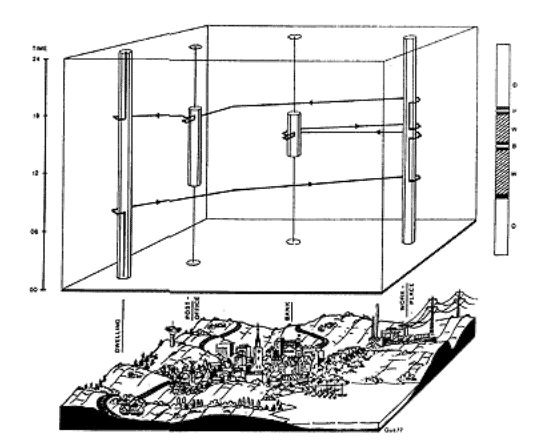
Setting aside the issue of nefarious intentions, we are reminded of the time-space work of the human geographers such as Nigel Thrift and Tommy Carlstein who did small scale studies of the space-time movements of people in local communities in the 1980s and since. And, too, we are reminded of the 2008 controversy stirred up when some scientists studying social networks used anonymized cell phone data on 100,000 users in an unnamed country.

Of course, the tracking of one's device is not the same as the tracking of oneself.  We can imagine iPhones that travel the world like that garden gnome in Amelie and people being proud not just of their own travels but where there phone has been. 

See also
  1. Technologically Induced Social Alzheimers
  2. Information Rot

Data Exhaust and Informational Efficiency

Heard an interesting talk by Paul Kedrosky a few weeks ago at PARC titled Data Exhaust, Ladders, and Search.

The gist of the talk is that human behaviors of all kinds leave traces which constitute latent datasets about that activity. Social scientists have long had a name for gathering this type of data: unobtrusive observation. Perhaps the most famous example is looking at carpet wear in a museum as a way of figuring out which exhibits captured the most visitor attention or garbology and related "trace measures used by anthropologist W. Rathje in the 70s and 80s.

One of Kedrosky's nicer examples was comparing aerial view of Wimbledon center court at the end of a recent tournament with one from the 1970s. The total disappearance of the net game from professional tennis was clearly visible in the wear patterns on the grass court.
In addition to a number of neat examples of using various techniques to capture "data exhaust" (indeed, he suggests, it's the entire principle behind google), he asks the question: What are the consequences of an instrumented planet? That is, a planet on which more and more data exhaust is captured and analyzed, permitting better decisions and more efficient choices.

In fact, one of the comments on Kedrosky's blog post about the talk (by one J Slack) suggests a continuing move toward "informational efficiency" -- with more and more instrumentation generating data and more and more connectivity, he suggests, "we'll be continuously approaching an asymptotic efficiency, though never quite getting there."

A standard definition of informational efficiency is "the speed and accuracy with which prices reflect new information" (TheFreeDictionary.com).  But there is some circularity here -- in this context it's only information if it does affect the price, otherwise it's mere noise.  And so we're still left with the challenge of sorting out the signal from the noise even after the data has been extracted from the exhaust.  And the more of everything the more of a job it is.

Bottom line: I think "data exhaust" is a great concept, but I don't think perfecting is capture and analysis gets you to a fully efficient use of information about the world (even asymptotically).  The second law of thermodynamics kicks in along the way for starters, but the boundedness of human cognition finishes the job.

Somebody is probably going to point out that evolution already does this.  But it takes big numbers and lots of time to do it and the result, though beautiful, is messy.

More to think about here, to be sure.